Search This Blog

Friday, May 14, 2010

'Cuz I'm Lonely, And I'm Blue...'

Those are lyrics from the nattily dressed Fontella Bass song "Rescue Me."

A French dive buddy called Pascal once told me the Rescue Diver course was his favorite because you do all the other courses for yourself; but you do Rescue Diver training for everybody else.

I got a kick out of this account, by "Samaka" (Anders Jälmsjö) on Scuba Jedi, of eventful Rescue Diver days on a liveaboard in the Red Sea.

But given the title, I was a little surprised that not everything that happened in Egypt actually stayed in Egypt.

Not all diver rescues are of the human variety, by the way. Sharks need love, too.

Thursday, May 13, 2010

Tall Tails

So Common Thresher Sharks really do whip small fish with their tails to kill or stun them.

I had thought this was fairly well established. But I guess these days no notion gets any respect until it's been caught on video.

But this aspect, courtesy of BBC, I did not know:

The discovery explains why thresher sharks are often caught by their tails by baited long-line fishing gear....

Fishermen often return sharks after the struggle of the catch, but because threshers tend to be caught by their tails, they have difficult breathing underwater when hooked.

BP's Oil Cataclysm And Your Hometown

Just how big is BP's Deepwater Horizon oil disaster so far? Well, go here to see the magnitude of the spill in comparison to where you live. (If you're the do-it-yourself type, you can find that here.)

The Eyes Have It

Stumbled across this video from last year of the Macropinna microstoma, a deepwater fish with a see-through head that no one appears to want to give a common name. (It's in the barreleye family; being no expert, it's binomial nomenclature looks like "Big-fin small-mouth" to me.)

The fish have been dragged to the surface for decades, but that inevitably leaves their delicate, fluid-filled frontal region mangled beyond recognition. The video is from the Monterey Bay Aquarium Research Institute.


Wednesday, May 12, 2010

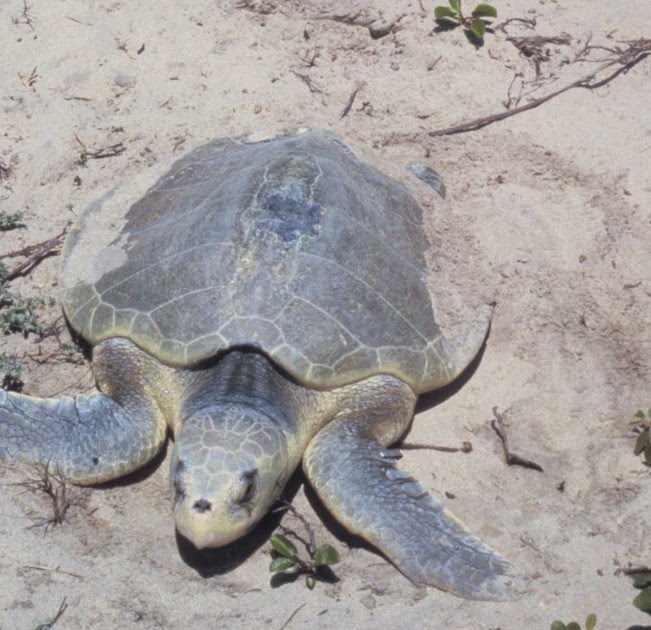
Damned If You Don't: Saving Turtles One Animal At A Time


["Damned If You Don't" are occasional discoveries that I think you'd regret not seeing.]

There's a terrific, encouraging feature by Amy Sutherland for Smithsonianmag.com on rescue efforts that begin at Cape Cod Bay, Massachusetts, where Kemp's Ridley Sea Turtles wash up after getting trapped in the cold bay waters.

They're mostly suffering from hypothermia and dehydration, and many are already dead or have one flipper in the grave by the time scientists or volunteers find them. But these folks do what they can, and in many cases save these endangered individuals (a tagged survivor turned up last summer to nest in Texas).
“Welcome to the real world, Bud,” a volunteer in surgical scrubs says to a turtle that she plucks out of a box. She lays the seemingly lifeless animal on an examining table. Jill Gary, a biologist with the aquarium, sinks a needle into the back of its neck and draws out thick, maroon-colored blood. Gary squirts yellow antiseptic into the animal’s eyes and checks the cornea for scratches. The volunteer has been holding a monitor to the turtle’s heart. “I’ve had only one heartbeat so far,” she says.

Gary inserts a rectal thermometer into the turtle and the animal springs to life....
This is my favorite "did you know...?" passage:
Charlie Innis, the aquarium’s head veterinarian, says the animals die if they warm up too quickly. As the turtle’s temperature rises, pathogenic bacteria that have lain dormant in its body also revive. The turtle’s immune system, compromised by hypothermia, isn’t up to the fight. The turtles are also susceptible to fungal infections. The main danger is pneumonia—about 20 percent of the turtles have it when they arrive, and perhaps 25 percent will contract it here.

The biologists have learned it’s best to warm the turtles by about five degrees a day....
As you can see, it's well-written and informative, and there's a (sappily sentimental) video component, too.

Webcast On Underwater Pioneers

Smithsonian Institution, National Science Foundation and the Ocean Studies Board of the National Research Council are going to webcast live on May 24-25 a Research and Discoveries seminar called "The Revolution of Science Through Scuba." It's something for all of us who grew up admiring Jacques Cousteau and kindred spirits like David Powell, the daring pioneers who have strapped on (or in some cases, invented!) tanks and taken the plunge in pursuit of undersea discovery. I'll be tuning in.


Monday, May 10, 2010

Piranha Shmiranha

I'm sorry, but I have to assume this is photoshopped until I see evidence to the contrary. Are you kidding me?!